
When Lucía Padilla’s son was born, there was only one way to get him to sleep: a song, the same song Lucía had once sung to him, almost by chance, while he was still in her belly.
At the time, she had no idea that talking or singing to an unborn baby could matter. Today, as a member of the AMOS Health & Hope staff, she shared that story with a circle of expectant mothers. It became the heart of this October’s Pregnancy Club, a session dedicated to prenatal stimulation and to the bond between a mother and the baby she is carrying.

What Is the Pregnancy Club?
AMOS Health & Hope works alongside rural communities in Nicaragua, training local people to care for the health of their own neighbors. In Nejapa, Managua, where AMOS has its offices and one of its urban clinics, the Pregnancy Club offers one of those spaces: a gathering where expectant mothers learn, ask questions and support one another through pregnancy. It is guided by a member of the AMOS staff and by Community Health Volunteers, mothers from Nejapa who give their time to share what they have learned.
This October, five expectant mothers attended, together with three Community Health Volunteers and Lucía, who facilitated the session. The topic: how a mother can begin stimulating and bonding with her baby long before birth.

A Conversation, Not a Lecture
Lucía didn’t open with a list of rules. She opened with questions. What do you do at home during the day? Do you ever talk to your baby? Have you noticed your baby moving at certain moments?
Her questions were conversational and free of judgment, and that made it easier for the mothers to answer honestly. Together they talked about everyday habits that support early stimulation, some they already practiced and others they could start, like uncovering the belly to let it catch the sun or simply talking to the baby.
Prenatal stimulation can sound technical, but at its core it is simple: offering a baby gentle, repeated experiences of light, sound and touch while it is still growing, and using those moments to build a bond between mother and child.

A Pink Light Across the Belly
Then the Community Health Volunteers took turns leading the practices.
The first volunteer focused on light. She showed the mothers how to cover a flashlight with pink tissue paper, and then slowly move the soft glow across their bellies. Each mother tried it herself.
The volunteer explained what they might notice. The baby would probably move, because the light was something new. With time, the baby would get used to it. Later in pregnancy, babies can perceive bright light that filters through the mother’s skin, and a slow, moving light gives them a gentle new experience to respond to.
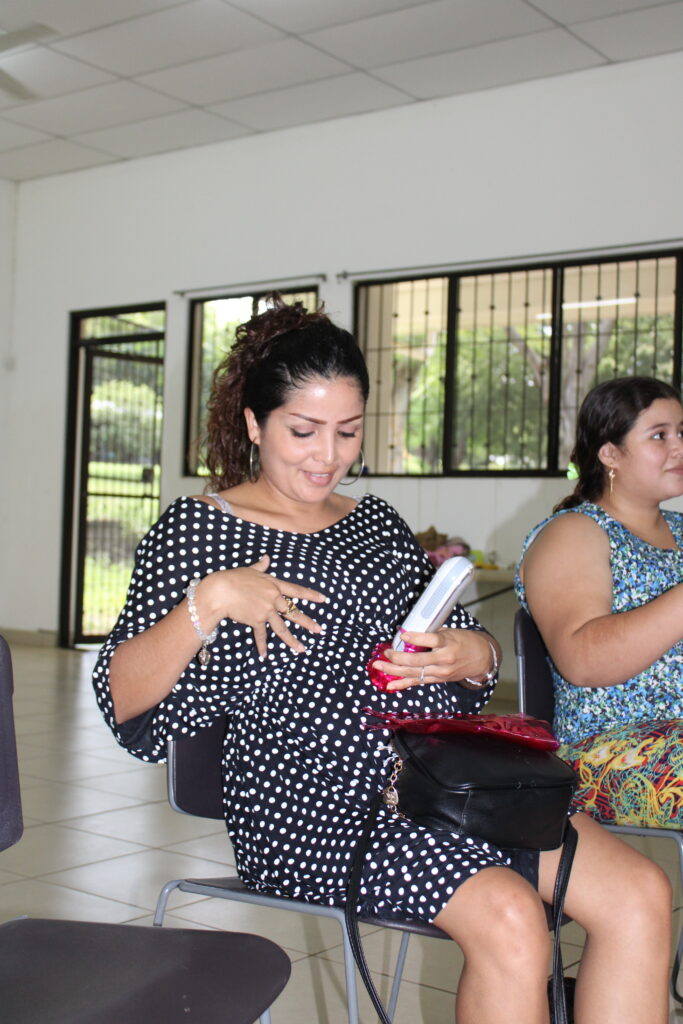
The Songs Babies Remember
Another volunteer spoke about sound: why a mother’s voice, spoken words and songs matter. By the second half of pregnancy, babies can hear voices and music from the outside world, and newborns often recognize the sounds they heard most before birth, especially their mother’s voice.
That’s when Lucía told the story of the song that became the only way her son would fall asleep. Heidi, one of the Community Health Volunteers, shared a similar experience with her own child.
The stories opened something up. Some of the mothers admitted that they didn’t talk to their babies. It hadn’t occurred to them, or it felt strange to speak to someone they couldn’t yet see. Rather than move on, the group stayed with it, and the rest of the meeting became a conversation about exactly that: why it can feel awkward, why it matters and how easy it is to begin. A few words while cooking. A song before sleep. A hand on the belly and a quiet “good morning.”

Why Small Habits Matter
None of the practices from this session cost money, what makes them work is knowledge, and the confidence to use it.
That is what the Pregnancy Club offers. Mothers don’t receive a lecture from outsiders. They learn from an AMOS staff member who has lived it, and from volunteers who are mothers from their own neighborhood. Each one leaves with something she can practice at home that same day.
And when these babies are born, some of them may already know a song.
Be Part of the Story
Programs like the Pregnancy Club are possible thanks to people who believe every family deserves health and hope. Learn how you can support community-led health care in Nicaragua.